
19.7K
Downloads
12
Episodes
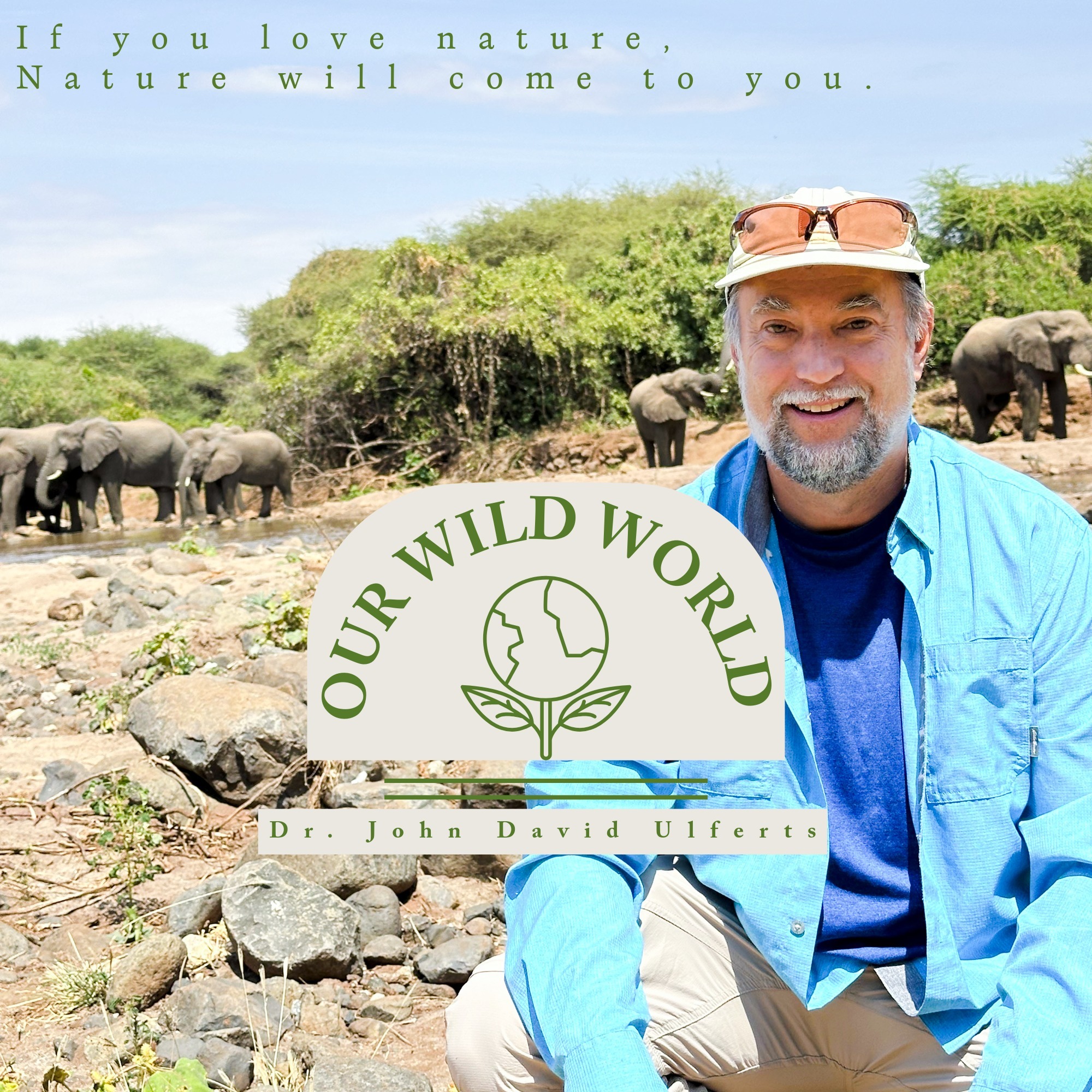
Our Wild World introduces listeners to, as the Lakota would say, Mitákuye Oyás’iŋ or, All Our Relations, in the animal world. Each episode is meticulously researched and includes firsthand observations from the bush of our 2 legged, 4 legged, and winged friends in the animal kingdom. The host, Dr. John David Ulferts, has been an educator for over 38 years serving as an Adjunct Professor, Superintendent, Principal, and Teacher. When John isn’t teaching, he’s traveling with his wife, Christina, also an educator and a conservationist, into the wild. Together they’ve sat in the cloud forest entertained by the shenanigans of a baby mountain gorilla as she hung from a vine, and played on the stomach of her napping silverback father. They’ve been startled as they sat alongside the campfire in the Okavango Delta by the thunderous roaring of two aggressive hippos who shook the ground as they fought just behind their tents. John and Chris have been woken from their sleep by a curious African lion who laid down outside their tent and played with their tent bag before carrying it off into the bush. John hiked through the forest accompanied by a Tanzanian National Parks ranger to come within 75 yards of an elephant family drinking from a stream. Walking to the toilet house one night while camping at Meru National Park in Kenya, John and Chris came eye to eye with a black mamba who lifted herself up just 12 feet from them, her beady eyes and flickering tongue warning them that she was about to strike. After all his time in the bush, John has a story or two to tell. So, it makes sense that he’s combining his passion for teaching with his passion for wildlife to launch Our Wild World. It’s a podcast like no other. Our Wild World’s webpage and sister Facebook, Instagram, X, and BlueSky pages all feature photographs and videos that John and Christina took of the animals featured in each podcast. Our Wild World’s mission is to educate listeners on our brethren in the animal world so that we can live in harmony with Nature and conserve the Earth’s vanishing wildlife. You can reach the host at ourwildworldshow@gmail.com Interested in advertising? Any profits generated by the podcast will be donated to wildlife conservation organizations. Special thanks to Viacheslav Starostin for the African Safari Music that is featured at the beginning and end of each podcast.
Episodes

Oct 13, 2026
Oct 13, 2026
36 min
Hyenas are amongst the most misunderstood and maligned animals, perhaps only rivaled by wolves, coyotes, and wild dogs. For too long, Africans and westerners have despised the hyena, viewing it as an ugly scavenger, when in fact, as we shall see, they are one of the most successful hunters in the animal kingdom. Hyenas possess many of the ethical principles that we admire most in the best human beings. Instead of fearing the hyena, and wanting to kill it, we need to develop a new ethos, based on factual knowledge, and give this amazing predator its due.
Sep 29, 2026
Sep 29, 2026
36 min
In this episode, you’ll learn about the most feared animal in all of Africa. No, it isn’t a lion, hippo, or crocodile. The Black Mamba, nicknamed Africa’s Death Kisser, is legendary for being the world’s deadliest snake. Its reputation is well deserved. Considered the world’s deadliest snake, the black mamba is extremely fast and aggressive when threatened. It’s bite is almost always fatal, and death occurs within 10 to 20 minutes. While effective black mamba antivenin does exist, it isn’t widely available in rural Africa where most black mamba deaths occur. Because death can occur in as little as ten minutes after a black mamba bite, antivenom must be administered immediately for it to be effective. It seems that every veteran safari goer has a story or two about the black mamba. I’ll share a few, as well as the extremely close encounter my wife and I had with a Black Mamba in 2022. It's one of the best black mamba stories I’ve ever heard, and we lived to tell it.
Sep 15, 2026
Sep 15, 2026
34 min
In this episode, we will learn all about the three species of zebras – the Plains, Mountain, and Grevy’s zebras. We will explore the physical and behavioral similarities between the species. Their social organization, habitats, ranges, diets, and their threats to survival will all be discussed. Finally, no discussion of zebras can be complete without addressing the various theories as to the function of those incredible stripes which make the zebra so endearing.
Sep 1, 2026
Sep 1, 2026
30 min
Cheetahs have long captured our the imagination of humans, and were frequently depicted in the artwork of the ancient Egyptians and San Bushmen of the Kalahari. As the fastest mammal on earth, cheetahs have an athletic body – long legs, a small, round head, slim torso, flexible spine, and semi-retractable claws. They can run breathtakingly fast – up to 70 mph (113 kph) – a speed they can reach astonishingly fast, in just three seconds. Cheetahs are more successful at killing prey than any of the other African cats. They are second only to wild dogs as the most successful predators. Cheetahs are successful at killing their prey about 70 percent of the time, an astonishingly high success rate for predators. Because they most typically hunt alone, cheetahs rarely take down prey larger than themselves. In this podcast, listeners will learn all about this fascinating predator.
Aug 18, 2026
Aug 18, 2026
31 min
In this podcast, we will learn about African buffalo, a formidable animal with a well-deserved reputation for being grumpy and unpredictable. The nicknames given to African buffalo reflect their formidable strength, short-temper, and unpredictability: Black Death, Widow Maker, and the Mafia of the Bush. Some Pygmy groups in Cameroon avoid buffalo because of a commonly held belief that it is inhabited by powerful evil spirits. We will introduce the different species of buffalo, their social organization, behavior, range, physical attributes, and their current status in the wild.
Aug 4, 2026
Aug 4, 2026
27 min
Leopards have the widest range of any of the great cats and can be found in any landscape from sea level to 17,000 feet. Their range includes all of sub-Saharan Africa and west of the Kalahari Desert as well as the Middle East and Asia. Yet, many a safari goer can attest that they are exceedingly hard to find on safari. This is because they are very shy, solitary, and do most of their hunting at night. Because they do not have a pack to depend on, leopards have to guard their kills against both lions and hyenas. Leopards are expert climbers and will drag their carcasses as high as 50 feet into the trees. Listen to this podcast and discover this elusive Prince of Stealth.
Jul 21, 2026
Jul 21, 2026
47 min
In this episode, Part 3 of the Gorillas in Our Midst miniseries, you’ll hear about the amazing treks my wife and I made to see the mountain gorillas that Dian Fossey studied at Volcanoes National Park in Rwanda, and the mountain gorillas of Uganda’s Bwindi Impenetrable Forest. Of course, along the way, we will also learn more about the behavior of mountain gorillas. If you haven't listened to the first two episodes, I encourage you to do so. Part 1 detailed my 1991 trip to see lowland gorillas at Kahuzi-Biega National Park in the Democratic Republic of the Congo, as well as my detention by Rwandan soldiers for taking a picture of the Presidential Palace. Part 2 focused on the life and work of ?Dian Fossey, and explored her still unsolved death detailing my conversations with her former lover, National Geographic photographer Bob Campbell, and her biographer, Canadian conservationist Farley Mowat. Be sure to check out the sister Facebook, Instagram, BlueSky or X pages for pictures accompanying this podcast.
Jul 7, 2026
Jul 7, 2026
41 min
This special three part miniseries from Our Wild World explores both lowland and mountain gorillas can be listened to in any order. Part 2 begins with the life and legacy of the American primatologist Dian Fossey – no one loved gorillas more. By the time Dian Fossey began her study of mountain gorillas in 1966, the species was well on the way to extinction due to poaching and habitat loss. Dian Fossey’s groundbreaking research of mountain gorillas and her battles to save them will be featured. Fossey’s active conservationism gained her much acclaim as well as some fierce enemies. Fossey was murdered the day after Christmas on December 26th, 1985. This episode becomes the only true crime podcast in the series as we investigate Fossey's still unsolved murder. I’ll share with viewers my conversation with Fossey’s lover, National Geographic photographer Bob Campbell, and my correspondence with her biographer, famed Canadian conservationist and author Farley Mowat, as well as American diplomats stationed in Kigali, Rwanda in the 1990s as to who may have killed her. My conversations with Bob Campbell and Farley Mowat have never appeared anywhere else. Part 2 also includes the fascinating story of Koko the gorilla, and the research Francine Patterson did teaching Koko American Sign Language and proving the intelligence of these amazing sentient beings. Part 1 introduced this misunderstood species. It took listeners back to Rwanda and Zaire in 1991. In Part 1 I told the harrowing story of how I almost became one of the first victims of the Rwandan genocide. Unknowingly, I took pictures of the Presidential Palace in Kigali, Rwanda. I was accused of being the wrong kind of guerrilla, a rebel from Uganda, and detained by soldiers. Then, I shared my trek to see the lowland gorillas at Kahuzi Biega National Park in the Congo (what was then Zaire). While the conservation of mountain gorillas has been a true success story, the lowland gorillas sadly are disappearing fast. They have the bad luck of being located in the Democratic Republic of the Congo which has always been a very unstable, war-torn region. Part 1 also featured my meeting with legendary German conservationist Conrad Aveling deep in the bush of the Congo. Part 3 will feature more research on the fascinating lives of mountain gorillas, and I’ll share our trek to see the descendants of the mountain gorillas Fossey studied at Volcanoes National Park in 2017. Part 3 then turns to Uganda's Impenetrable Forest and tracking gorillas there. Check out our companion Facebook and Instagram sites for pictures my wife and I have taken in the bush.
Jun 23, 2026
Jun 23, 2026
45 min
In this special three part miniseries from Our Wild World, we will explore the behavior of both lowland and mountain gorillas. For many of us of a certain age, the first gorilla we ever became aware of was King Kong, scaling the Empire State Building and batting airplanes and helicopters like they were no more than bothersome flies. The film reflects the prevailing misconception of gorillas that dated back to their discovery in the mid-19th century as being fierce, even monstrous creatures. Almost as soon as they were discovered, European and American trophy hunters began hunting them. By the time Dian Fossey began her study of mountain gorillas in 1966, the species was well on the way to extinction due to poaching and habitat loss. Part 1 introduces this misunderstood species. I'll take listeners back to Rwanda and Zaire in 1991. I'll tell the harrowing story of how I almost became one of the first victims of the Rwandan genocide. Unknowingly, I took pictures of the Presidential Palace in Kigali, Rwanda. I was accused of being the wrong kind of guerrilla, a rebel from Uganda, and detained by soldiers. Then, I'll share my trek to see the lowland gorillas at Kahuzi Biega National Park in the Congo (what was then Zaire). While the conservation of mountain gorillas has been a true success story, the lowland gorillas sadly are disappearing fast. They have the bad luck of being located in the Democratic Republic of the Congo which has always been a very unstable, war torn region. It was in 1991 as well when I took my trip there. In this episode, I will also describe my meeting with legendary German conservationist Conrad Aveling. Part 2 will explore Dian Fossey’s groundbreaking research of mountain gorillas, her battles to save them, and her untimely, still unsolved death. I’ll investigate her death by sharing with listeners who Fossey’s lover, National Geographic photographer Bob Campbell, suspected was her killer as well as my correspondence with her biographer, famed Canadian conservationist Farley Mowat, and what the American diplomats stationed in Kigali, Rwanda in 1991 told me. Part 2 will also include the fascinating story of Koko the gorilla, and the research Francine Patterson did teaching Koko American Sign Language and proving the intelligence of these amazing sentient beings. In Part 3, I will recount tracking the mountain gorillas, descendants of the family members Fossey studied, at Volcanoes National Park in 2017. Then, I will detail our trek into Uganda's Impenetrable Forest to see mountain gorillas there. This episode will include more research on the complex social behavior and lives of mountain gorillas. Check out our companion Facebook and Instagram sites for pictures my wife and I have taken in the bush.
Jun 9, 2026
Jun 9, 2026
45 min
In this special three part Elephants Among Us series of Our Wild World, we will explore the savannah elephants of Africa. If you’ve missed the first two episodes, I recommend you go back to listen to them before starting this third episode. In Part 3 of Elephants Among Us, we will further explore elephant adolescence and the importance of play. I'll share an amazing farewell that an elephant family gave Chris and I at Masai Mara National Park. Then, I'll recommend the best parks in Africa to see elephants, some excellent books and films on elephants, the threats to elephant survival, and the organizations working to save them. Finally, I'll take listeners on a tour of the Save the Elephants research facility at Samburu National Reserve and to the Sheldrick Wildlife Trust in Nairobi to see the orphaned elephants cared for there.
May 19, 2026
May 19, 2026
46 min
In this special three part Elephants Among Us series of Our Wild World, we will explore the savannah elephants of Africa. In Part Two we will dig deeper into elephant communication, including the recent exciting discovery that elephants use unique names to identify each other, and its implications. I'll share the amazing account of a lone female elephant in South Africa apparently using infrasound to communicate with a blue whale just off the coast. Then, I'll also recount how Chris and I saw a large bull elephant bully a family at Amboseli National Park, and how they used infrasound to call for help from another large bull. We will also learn how ethologists have learned to identify individual elephants in the field. Finally, we will discuss the different lives bull elephants lead from matriarchal led families as well as elephant babies. I will share the amazing encounter I had with a family of elephants while hiking at Lake Manyara National Park, where the great elephant conservationist Dr. Iain Douglas Hamilton, founder of Save the Elephants and the Elephant Crisis Fund, began his studies of elephant migration routes in 1965. I'll also share how patient and polite elephants are when it comes to queuing in line.
Apr 25, 2026
Apr 25, 2026
44 min
In the first of a three part Elephants Among Us series of Our Wild World, we will explore the savannah elephants of Africa. Elephants are highly intelligent, emotional and social beings and you’ll learn all about their strong family bonds, their social behavior, the different roles of males and females, their unique anatomy, and the truly amazing discoveries being made on how elephants communicate. Elephants are the gardeners and architects of Africa spreading seeds and creating habitat wherever they go. Yet they could disappear within our lifetime due to poaching, habitat loss, and climate change without our help. You’ll also learn about brave ethologists such as Iain Douglas-Hamilton, Cynthia Moss, and Joyce Poole who have contributed vastly to our knowledge of these remarkable creatures and have dedicated their lives to elephant conservation. My wife, Christina and I have studied elephants in Kenya, Tanzania, Botswana, Zimbabwe, South Africa, and Uganda, and are own adventures will be included. Finally, be sure to check out our companion Our Wild World website, Facebook, Instagram, BlueSky, or X pages to see pictures of the elephants discussed in these podcasts.
Gentle Giants - Elephants
An Annotated Bibliography
Books
Anthony, Lawrence. The Elephant Whisperer (2009). The South African conservationist rescued an elephant family that was going to be put down by authorities and instead released them into the Thula Thula Reserve where the elephants accepted him and allowed him to become a part of their extended family.
Chadwick, Douglas H. The Fate of the Elephant (1992). This is a beautifully written comprehensive book on elephants – scientific research with personal travelogue, detailing the elephants' intelligence, communication, and family structures while highlighting the threats they face and the human conflicts surrounding them. Highly recommended.
Douglas-Hamilton, Iain and Oria. Among the Elephants (1975) and Battle for the Elephants (1992). Both of these are remarkable books by the Douglas-Hamiltons who have spent their life advocating for the elephants. Iain founded Save the Elephants, which is part of the Wildlife Conservation Network and is the premier charity supporting elephants. Iain was also instrumental in conducting the Great Elephant Census in 2017 which found the elephant population had decreased by 30% in just seven years and was recorded at 352,271 in 18 African countries.
Kahumbu, Paula and Geib, Claudia. Secrets of the Elephants (2023). A tie-in to the National Geographic series of the same name, this book explores elephant intelligence, family bonds, and behavior through stunning photography and scientific research. Kahumbu is a Kenyan wildlife conservationist and CEO of WildlifeDirect.
Moss, Cynthia. Elephant Memories (1988) and Portraits in the Wild: Animal Behavior in East Africa (1975). Moss had spent 13 years in Kenya’s Amboseli studying elephants when she wrote Elephant Memories. She arrived in Africa as an American journalist and never left. She has tracked generations of elephant families and intimately knows their families. Portraits in the Wild features a number of African animals with only one chapter on elephants but is also terrific reading.
Safina, Carl. Beyond Words: What Animals Think and Feel (2015). This is a life changing book. Safina focuses on three species - elephants, wolves, and killer whales, but includes many others, as he explores the latest scientific findings on animal intelligence. The book updates Elephant Memories as the chapter on elephants focuses on Cynthia Moss and Amboseli. In beautiful prose, Safina argues that animals are sentient beings and deserve to be treated humanely.
Sheldrick, Daphne. Love, Life and Elephants: An African Love Story (2012). Daphne recalls her husband, a Kenyan wildlife warden, and tells the story of the elephant orphanage she started in his honor. The Sheldrick Wildlife Trust has rescued over a hundred elephant orphans and reintegrated them into the wild.
Films:
Soul of the Elephant (2015) - PBS Nature - Famed wildlife photographers Dereck and Beverly Joubert narrate this loving documentary about elephants, their behavior, social structure, and the threats they face. The Jouberts capture some of the awe that elephants leave us with, and how they make us better beings just by spending time with them.
The Best Charities Supporting Elephants
Save the Elephants part of the Wildlife Conservation Network. Started by Iain Douglas-Hamilton this elephant organization has been instrumental in saving elephants throughout Africa and fighting against poaching. 100% of their contributions go to the effort with no administrative overhead. Outstanding.
https://www.savetheelephants.org/
Elephant Crisis Fund, also a part of the Wildlife Conservation Network. This charity, also started by Iain Douglas-Hamilton, awards grants to the most effective projects and partners in Africa, and in ivory consuming nations, to end the ivory crisis, promote human-elephant coexistence, and protect elephant landscapes, to secure a future for elephants. To date, it has worked in 44 countries, funding 559 projects, with 120 partners. It is a model of elephant activism.
https://wildnet.org/wildlife-fund/elephant-crisis-fund/
Sheldrick Wildlife Trust. This Kenyan orphanage has rescued and reintegrated over a hundred elephants into the wild. Rangers live with the infant elephants nursing them until they can be reintroduced. You can adopt a baby for just $50 per year.
https://www.sheldrickwildlifetrust.org/
Amboseli Trust for Elephants. This organization was founded by Cynthia Moss and protects the elephants of Amboseli and continues her research studies there.
https://www.elephanttrust.org/
Elephants Across Borders. This is the premier charity supporting southern Africa’s elephants. Botswana has the largest population of elephants left in the wild. This is the group that helps protect them.
https://elephantswithoutborders.org/